Last summer, we were three hours from home when Junie’s phone died. We were in a state park with spotty service, and I needed the map app to find the trailhead back to the car. Margo was already asking for her tablet, and I realized I was the only one with a battery left. That panic is exactly why we carry power banks now. But when you’re watching every dollar, spending $80 on a battery pack feels like a luxury we don’t always need. I’ve tested dozens of these over the years, from the ones that died in a week to the ones that still work after three years of being tossed in the backseat. Here is what actually works for a family on a budget.
The Real Cost of a Dead Phone
When you’re camping on a budget, the goal is to save money on hotels and flights. But technology has become a non-negotiable part of the trip. We need phones for GPS, cameras for memories, and tablets to keep the girls entertained during long car rides. The problem is that state parks rarely have outlets, and campgrounds often have shared power stations that are either broken or occupied by the RV next door.
I used to think any battery pack would do. I’d grab the cheapest one I could find at the big box store, thinking it was a win for the budget. But after the third time a $15 pack stopped holding a charge after two months, I realized I was spending more in the long run. A “false economy” is when you save money upfront but pay for it later in replacements or frustration. For a single mom, frustration is a cost we can’t afford. We need gear that survives the rough handling of two energetic kids and the unpredictability of the outdoors.
The best budget portable power bank for camping isn’t just about the price tag; it’s about reliability. It needs to be safe enough to leave in a hot car, durable enough to survive a drop, and powerful enough to charge a phone at least twice. I’ve narrowed down the options to what actually fits our life and our wallet.
 Photo: Uriel Mont
Capacity Math: How Much Power Do You Actually Need?
One of the biggest confusions when buying these packs is the capacity number. You’ll see 10,000mAh, 20,000mAh, or even 30,000mAh. It sounds like bigger is always better, but there is a catch. First, you have to remember that the number on the box is the internal battery capacity, not the output. Because of energy loss during transfer, you usually get about 60% to 70% of that number in real-world charging.
For our family, a 10,000mAh bank is usually the sweet spot. It’s small enough to fit in a daypack without weighing us down, but it can charge a modern smartphone about two to three times. If you are planning a weekend trip with just the essentials, that is plenty. If you are going for a week and need to charge tablets and cameras, you might need 20,000mAh. However, those larger packs get heavy and often push the price over our $40 limit.
I always tell the girls to check their battery percentage before we leave the campsite. If we are going hiking, we charge up before we leave. If we are staying at the campsite, we plug in when we can. The goal is to keep the power bank itself charged. I’ve learned the hard way that a dead power bank is just a heavy brick in your pocket.
 Photo: Kampus Production
Durability: The “Mom Test”
In the lab, these devices are tested on smooth surfaces. In our house, they are tested on gravel, carpet, and sometimes the floor of a minivan. I look for a rubberized exterior. Smooth plastic feels cheap and slips out of hands easily. A rubberized coating gives it grip and protects it from minor bumps.
Safety is another huge factor. Lithium-ion batteries can get hot, especially in the summer heat of a car. I’ve seen cheap packs swell up or stop working after being left in a hot trunk. The ones I recommend have built-in temperature control. They might charge a little slower, but they won’t overheat and shut down when the girls are trying to charge their devices in the middle of the day.
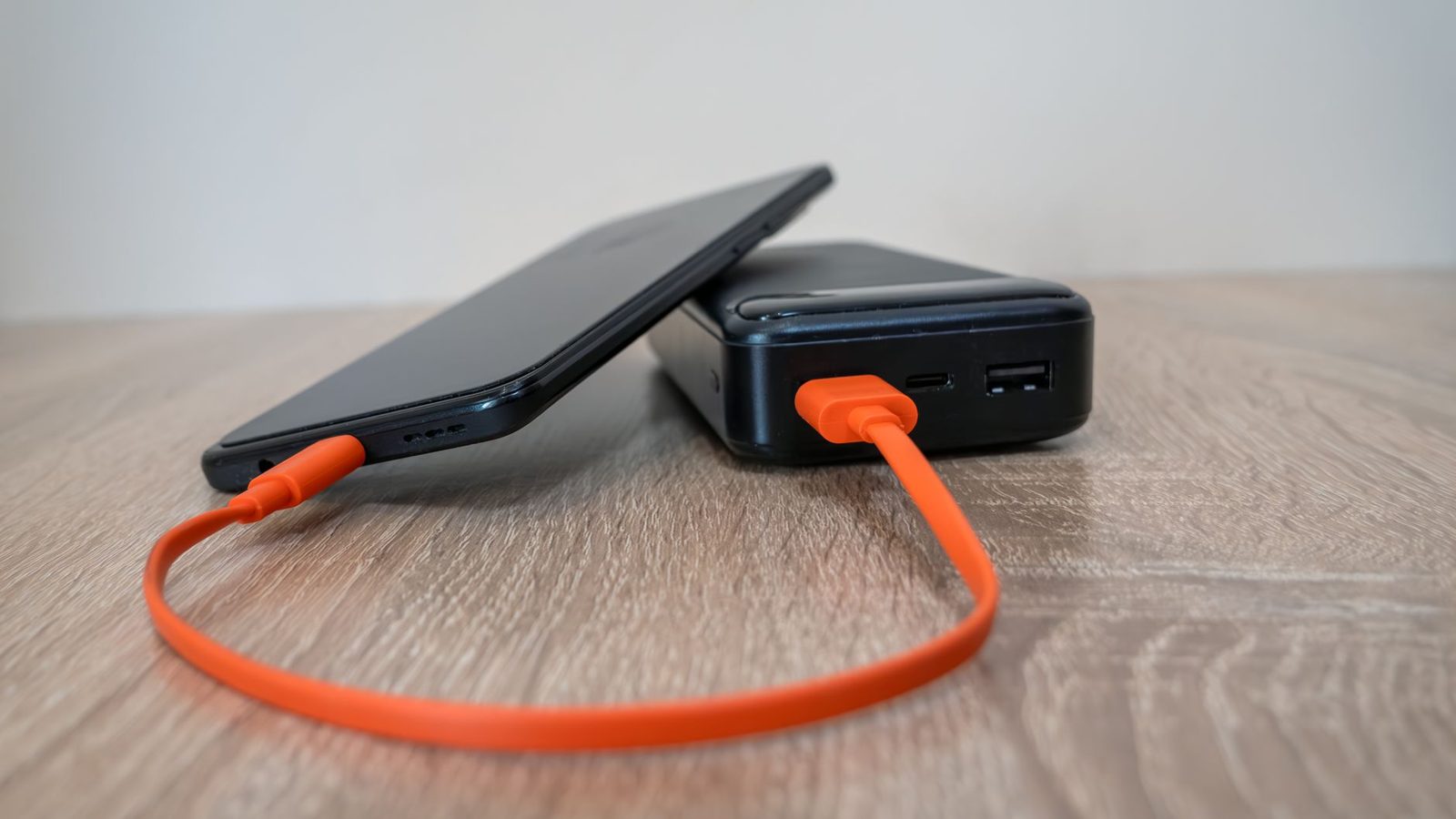
Cable compatibility is also something I check. Some budget packs come with a built-in cable, which is great because you don’t have to hunt for one. Others require you to bring your own. I prefer packs that have USB-C ports because that is the standard for most newer phones and tablets. It means I only need to carry one type of cable for the whole family.
Solar Charging: The Honest Truth
You will see a lot of power banks under $40 that advertise “Solar Charging.” They look cool with little panels on the back. Here is the truth: on a budget model, solar is mostly a backup for emergencies, not a primary charging method.
I tested a solar power bank last summer. It took about 40 hours of direct sunlight to fully charge the bank itself. That is fine if you are stranded in the wilderness, but for a normal camping trip, it’s too slow to rely on. The solar panels on these cheap units are small and inefficient. They are better used as a way to top up the battery over a few days of sun, rather than charging your phone directly.
If you buy a solar bank, make sure it has a high capacity (20,000mAh or more) so the solar feature is just a bonus. Don’t pay extra for it expecting it to replace a wall charger. For our family, a reliable wall-charged bank is better than a solar one that never gets full.
What I Actually Bought: Top Picks Under $40
I’ve tested these specific models with the girls over the last year. They have been through state parks, national forests, and roadside stops. Here is where the money is best spent.
- Compact size
- fast charging
- durable build
- No built-in cable
- USB-A only on some models
The Anker PowerCore 10000 is the gold standard for budget camping. I bought this one three years ago, and it still holds a charge like new. It is small enough to fit in a pocket, which means the girls don’t have to carry it in a heavy backpack. It charges my phone about three times, which is enough for a weekend. The build quality is solid; it has survived drops from the picnic table more than once. The only downside is that it doesn’t come with a cable, so make sure you have one in your kit.
- Affordable price
- USB-C input and output
- lightweight
- Plastic feels less rugged than Anker
If you want to save a few more dollars, the Baseus Mini is a solid choice. It supports USB-C, which is great for newer phones and tablets. It is lighter than the Anker, which is nice if you are backpacking. The price is hard to beat, and it does the job well. However, the plastic casing feels a bit more fragile. I keep this one in a protective pouch so it doesn’t get scratched up in the gear bag. It’s a good backup option if you need to buy two for the family.
- High capacity
- built-in solar panel
- flashlight included
- Slow solar charging
- heavy
- bulky
I bought this solar bank for a specific trip where we were going off-grid. It has a high capacity, which is great for longer trips. It also has a built-in flashlight, which is handy for finding things in the tent at night. But be warned: the solar charging is slow. It works, but don’t expect it to charge your phone in an hour of sun. It’s heavy, so I only take it on car camping trips where weight isn’t an issue. It’s a good safety net, but not my daily driver.
Safety and Longevity Tips
To get the most out of your budget power bank, you need to treat it right. First, don’t leave it in the car during extreme heat. If you are going to be gone for the day, bring it inside the cabin or into the tent. Extreme cold can also drain the battery faster, so keep it close to your body if it’s freezing.
Second, try not to let it drain to zero every time. Lithium batteries last longer if you keep them between 20% and 80%. I charge it up before every trip, even if I don’t think I’ll need it. It’s better to have extra power than to find out it’s dead when you need it.
Finally, check the warranty. Most budget brands offer a one-year warranty. If it dies within that time, they usually replace it. It’s worth checking the return policy before you buy. I’ve had to use the warranty once, and it was a smooth process. That peace of mind is worth the extra few dollars sometimes.
FAQ: Common Questions About Camping Power
1. Can I bring a power bank on a plane? Yes, most airlines allow power banks in your carry-on bag. They usually need to be under 100Wh, which covers most 10,000mAh and 20,000mAh packs. Just make sure it’s in your carry-on, not checked luggage, because of the battery safety rules.
2. How long does a 10,000mAh bank last? In real-world use, a 10,000mAh bank will charge a standard smartphone about two to three times. It depends on your phone’s battery size and how much you use it while charging.
3. Do I need a special cable? Most budget packs come with a USB-A to Micro-USB or USB-C cable. If you have a newer phone, you might need a USB-C to USB-C cable. It’s always good to check what ports your devices use before you pack.
4. Is it safe to charge devices overnight? Yes, modern power banks have safety features to stop charging when the device is full. However, I still prefer to unplug them in the morning to save battery life on the pack itself.
5. What if the power bank gets wet? Most budget packs are water-resistant but not waterproof. If it gets caught in the rain, wipe it dry immediately. If it gets soaked, let it air dry for a day before trying to charge it again.
6. How do I know if it’s still working? If the battery indicator lights don’t turn on when you press the button, it might be dead. You can try charging it for a few hours. If it still doesn’t hold a charge, it’s time to recycle it and buy a new one.
Wrapping Up
Camping should be about disconnecting from the stress of the world, not stressing about your battery life. With the right power bank, you can keep the maps running and the kids entertained without breaking the bank. I hope these picks help you get out there without worrying about finding an outlet.
Remember, the best gear is the gear that works when you need it. Whether you choose the reliable Anker or the budget-friendly Baseus, just make sure you test it before you leave home. Happy camping, and see you on the trail.
— Penny